 07 3375 6777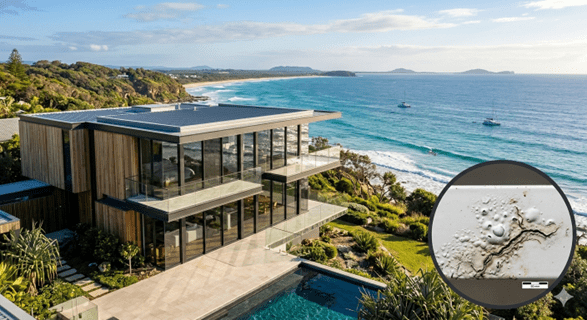
In Queensland, the coastline isn’t just a lifestyle; it is one of the most punishing corrosive environments on the planet. From the Gold Coast to the Sunshine Coast, the combination of high humidity, intense UV radiation, and airborne chlorides (salt) creates a “perfect storm” for metal degradation.
For many builders, architects, and homeowners, the assumption is that powder coating provides an impenetrable shield. However, if you apply “standard” powder coating specifications to a project within five kilometres of the ocean, you aren’t just risking a bit of fading—you are inviting systemic structural failure.
At Superior Coaters, we’ve seen “standard” jobs bubble and peel within 18 months. To avoid this, you need to understand the Coastal Corrosion Calculus.
1. The Chemistry of the “Salt Spray” Zone
To understand why standard specs fail, we have to look at the microscopic level. Standard powder coating involves a single layer of decorative polymer over a basic pre-treatment. In a dry, inland environment like Toowoomba, this is perfectly adequate.
However, in coastal QLD, salt particles are hygroscopic—they pull moisture out of the air. This creates a concentrated electrolyte solution that sits on the surface of your metal. If there is even a microscopic pore in the powder finish, this electrolyte initiates an electrochemical reaction.
The Filiform Threat
The most common failure in coastal regions is filiform corrosion. It looks like small, frantic “worms” or spiderwebs tunnelling under the paint.
This occurs when the bond between the coating and the metal is compromised. Once the “head” of the worm starts, it creates its own micro-environment, eating away at the aluminium or steel regardless of how often you wash the surface.
2. Why the “Standard” 60-Micron Spec is a Gamble
In the industry, many coaters aim for a standard thickness of roughly 60 to 80 microns. While this looks great on day one, it offers very little “sacrificial” protection against the abrasive nature of coastal winds.
Salt spray doesn’t just sit; it’s often driven by high winds, acting like a very fine sandpaper. Over time, a standard 60-micron coat thins out. Once it drops below a critical threshold, the UV rays of the Queensland sun begin to degrade the resin binder, making the coating porous.
The Superior Approach: For coastal environments (defined as anything within 5km of high-tide), we recommend a “Marine Grade” system. This often involves a high-build approach or a specialized two-coat system (primer + topcoat) to ensure a barrier that can withstand both chemical attack and physical abrasion.
3. The Invisible Hero: Multi-Stage Pre-Treatment
If you take away nothing else from this article, remember this: The quality of a powder coat is 90% determined before the powder is even sprayed.
In a coastal calculus, the pre-treatment is what prevents filiform corrosion. Many budget coaters use a simple “wash and dry” method. For coastal longevity, you need a sophisticated chemical conversion coating.
The Shift to Chromate-Free Technology
Traditionally, hexavalent chromium was the gold standard for corrosion resistance, but it was environmentally devastating. Today, we utilize advanced zirconium-based or chrome-free conversion coatings.
These chemicals don’t just sit on top of the metal; they transform the surface of the aluminium into a non-reactive, ceramic-like layer. This layer acts as a “bridge” that chemically welds the powder to the metal, ensuring that even if the coating is scratched, the corrosion cannot spread laterally under the film.
4. Material Matters: Aluminium vs. Steel
The “calculus” changes depending on your substrate.
- Aluminium: Naturally forms an oxide layer, but in the presence of salt, it suffers from “pitting.” A marine-grade powder spec on architectural-grade aluminium is the “gold standard” for QLD coastal builds.
- Steel: Coastal steel is a different beast entirely. Without Hot Dip Galvanizing or a Zinc-Rich Primer underneath the powder coat, steel will begin to bleed rust through the finish almost immediately. In the “Salt Zone,” we advocate for a “Duplex System”—the synergistic combination of galvanizing and powder coating.
5. Maintenance: The “Wash or Lose” Reality
One of the biggest misconceptions in the Australian market is that powder coating is “maintenance-free.”
Even the highest-spec marine coating will fail if salt is allowed to sit on the surface and “cook” in the sun. For a warranty to remain valid in a coastal area, a documented cleaning cycle is usually required.
- Inland: Wash every 6–12 months.
- Coastal (within 5km): Wash every 3 months with fresh water and a mild pH-neutral detergent.
This prevents the accumulation of salt “crusts” which can create a localized high-concentration cell that eats through even the toughest polymers.
6. Specifying for Success: Questions to Ask Your Coater
If you are an architect or a builder working on a coastal project, don’t just ask for “Black Matte.” Use the following checklist to ensure your “Coastal Calculus” adds up:
- What is the pre-treatment process? (Look for multi-stage chemical immersion, not just a spray-over).
- Is the powder “Architectural Grade”? (Ask for Class 2 or Class 3 powders, which have higher UV resistance).
- What is the target micron thickness? (Aim for higher builds in high-corrosion zones).
- Do you provide a warranty for “Category C5” environments? (C5 is the ISO classification for very high marine corrosivity).
Conclusion: Investing in the “First Time” finish
In the competitive world of Queensland construction, it’s tempting to shave costs on the finishing. However, the cost of “re-coating” an installed gate, balustrade, or window frame is often 5x the cost of the original job, once you factor in removal, transport, and re-installation.
At Superior Coaters, we don’t just apply colour; we engineer a defence system. By understanding the chemical realities of the Queensland coast and refusing to cut corners on pre-treatment and powder quality, we ensure that your project doesn’t just look “superior” on the day of handover—it stays that way for a decade or more.
