 07 3375 6777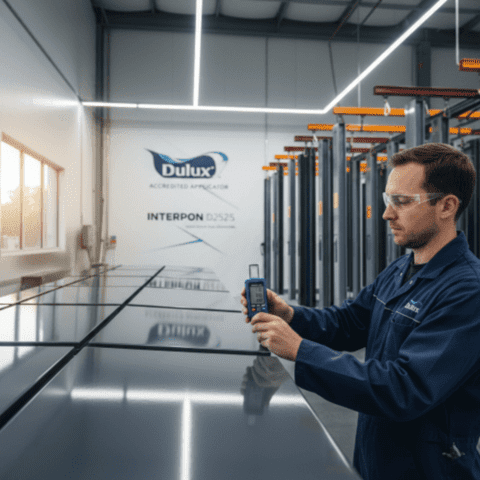
When you are specifying the finish for a multi-million dollar infrastructure project or a high-end architectural build, the term “powder coated” is often used as a catch-all. In reality, powder coating is not a commodity; it is a complex chemical process where the margin for error is measured in microns.
For many project managers and architects, the focus is often on selecting the right product—perhaps a Dulux Duratec® or an Interpon D2525—under the assumption that the brand name alone carries the weight of the warranty. However, there is a critical distinction that often goes unnoticed until a coating fails: the difference between the product and the application.
In Australia, a manufacturer’s warranty is only as strong as the applicator who applies it. This is why choosing an Accredited Applicator like Superior Coaters isn’t just a badge of quality—it is the only way to ensure your asset is legally and technically protected for the long term.
The “Powder” vs. The “Process”
It is a common misconception that if a powder coater buys a box of Dulux powder, the finished product automatically comes with a Dulux warranty. This is incorrect.
Dulux and Interpon (AkzoNobel) do not offer “blanket” warranties on their powders because they cannot control how the powder is used once it leaves their warehouse. A premium powder applied over a poorly prepared surface or cured at the wrong temperature will fail just as quickly as a cheap alternative.
To bridge this gap, these global giants created Accreditation Programs. These programs hand-pick a small percentage of Australian coaters who have proven they can meet stringent international standards.1 When you work with an accredited partner, you are hiring a facility that has been audited to ensure their pretreatment, application, and curing processes are flawless.2
Why Accreditation is Mandatory for Warranties
If you are looking for a Dulux Alumi Shield™ or Steel Shield™ warranty, or an Interpon D-Series performance guarantee, accreditation is not optional—it is a prerequisite.3
- The Audit Trail: Accredited applicators undergo rigorous audits (often every 18 months).4 This includes laboratory testing of coated samples to check for film thickness, adhesion, and cure.
- Surface Preparation: Up to 90% of coating failures are caused by poor pretreatment. Accredited coaters must follow specific chemical or mechanical (sandblasting) cleaning protocols that non-accredited shops may skip to save time.
- The Warranty Certificate: Only an accredited applicator has the legal authority to issue a project-specific warranty certificate.5 Without this certificate, your “warranty” is essentially non-existent in the eyes of the manufacturer.
The Real-World Risk of Non-Accredited Coating
In the harsh Australian climate—where UV levels are extreme and salt spray can reach kilometres inland—a “standard” powder coat can begin to degrade in as little as 24 months. Common issues include:
- Chalking: The resin breaks down under UV light, leaving a white, powdery residue and causing the colour to fade.
- Delamination: The coating peels away from the metal in sheets because the surface wasn’t etched or primed correctly.
- Filiform Corrosion: Small, thread-like corrosion bubbles form under the surface, eventually eating into the substrate.
For a non-accredited job, the cost of rectification is usually 3–4 times the original price of the coating, as the item must be uninstalled, stripped, recoated, and reinstalled. By specifying an accredited applicator from the start, you shift this risk back to the manufacturer and the coater.
Understanding the Standards: AAMA and Beyond
Accreditation ensures that the work complies with global benchmarks. These standards categorize coatings based on their performance:
|
Standard |
Performance Level |
Typical Use Case |
|
AAMA 2603 |
Standard Durable |
Residential windows, internal partitions. |
|
AAMA 2604 |
High Performance |
Commercial entries, schools, high-traffic areas. |
|
AAMA 2605 |
Superior Performance |
High-rise curtain walls, monumental landmark structures. |
An accredited applicator understands these nuances. They won’t just ask “what colour do you want?”; they will ask about the project’s distance from the coast, the height of the building, and the expected maintenance schedule to ensure the right AAMA standard is met.
The Superior Coaters Difference
At Superior Coaters, our accreditation with Dulux and Interpon is the cornerstone of our operation. When combined with our massive 14-metre oven and our specialized sandblasting facilities, we offer a level of quality assurance that few in Australia can match.
We don’t just “paint” metal; we engineer a protective barrier. Our status as an accredited partner means that for every project—from small architectural fins to massive industrial beams—we provide:
- Pre-approval of specifications to ensure the right product for the environment.
- Rigorous quality logs recorded during every stage of the process.
- Genuine manufacturer warranties that protect your investment for up to 25 years.
Conclusion: Don’t Leave it to Chance
In the world of metal finishing, the cheapest quote is often the most expensive in the long run. Choosing an applicator based solely on price usually means sacrificing the very accreditation that makes your warranty valid.
Whether you are an architect drafting a specification or a builder looking for peace of mind, always ask for the applicator’s Accreditation Certificate. It is the only way to ensure that the “premium finish” you paid for actually delivers the performance you expect.
