 07 3375 6777
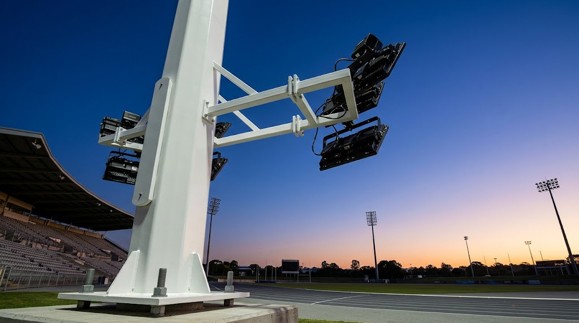
Tall metal infrastructure—including sports lighting masts, utility poles, and communication towers—operates in aggressive outdoor environments. These structures experience constant mechanical stress, severe wind loading, thermal expansion, and intense ultraviolet (UV) radiation. Without advanced surface engineering, towering metal assets suffer from premature corrosion, structural thinning, and aesthetic degradation.
Traditional wet-paint systems frequently fail on high-rise infrastructure due to chalking, peeling, and poor edge retention. Advanced powder coating provides a superior, long-term finishing solution by electrostatically fusing a durable thermosetting polymer directly to the metal substrate, delivering decades of maintenance-free service.
Core Engineering Challenges of Tall Infrastructure
Engineering assets exceeding 10 metres in height introduces complex environmental and physical hurdles. Asset specifiers must account for:
- High Wind Shear: Elevation amplifies wind forces, causing continuous micro-vibrations and structural flexing that can fracture brittle coatings.
- Intense UV Exposure: Unfiltered solar radiation degrades standard paint resins, resulting in rapid fading and surface chalking.
- Moisture and Condensation Pooling: Rainwater collects around joints, gussets, and baseplates, accelerating galvanic and crevice corrosion.
- Prohibitive Maintenance Costs: Servicing tall structures requires costly equipment such as elevated work platforms, lane closures, or cranes.
To counteract these vulnerabilities, heavy-duty applications require rigorous pre-treatment and high-capacity baking infrastructure. For further details on heavy-duty preparation standards, refer to the Industrial Durability Solutions guide.
Comparative Performance Analysis
The table below outlines how advanced powder coating compares against conventional liquid paint systems for high-reach municipal and industrial assets.
| Performance Metric | Advanced Powder Coating | Traditional Wet Paint |
| Design Life | 15 to 25+ years with minimal maintenance | 5 to 8 years before major recoating |
| Edge & Weld Coverage | Uniform film thickness across sharp edges and welds | Prone to paint thinning and premature failure on sharp corners |
| Environmental Profile | Zero volatile organic compounds (VOCs); overspray is fully recyclable | High solvent emissions and hazardous chemical waste |
| Impact & Abrasion Resistance | Cross-linked polymer bonds resist scratching, chipping, and wear | Softens over time; vulnerable to mechanical impacts and stone chips |
| Warranty & Compliance | Backed by manufacturer warranties up to 20 years (Dulux/Interpon) | Limited warranties typically restricted to raw material defects |
The Multi-Stage Application Process for Oversized Poles
Coating tall masts requires precise thermal and mechanical control. Because sports lighting poles exceed standard factory dimensions, applicators utilise specialised, heavy-duty workflows:
- Abrasive Blast Cleaning: Steel substrates are blast-cleaned to Sa 2.5 standards (ISO 8501-1) to strip mill scale and rust, establishing an ideal surface anchor profile.
- Zinc-Rich Epoxy Priming: A high-performance zinc-rich primer is applied as a sacrificial barrier to actively inhibit sub-film corrosion if the outer coating is compromised.
- Electrostatic Powder Deposition: Specially formulated architectural-grade polyester powder is applied via electrostatic spray guns, guaranteeing complete encapsulation of complex brackets and welds.
- Thermal Curing: Masts are cured in large-capacity thermal ovens, allowing the polymer particles to melt, flow, and cross-link into a dense, chemically resistant shield.
Beyond sports facilities, protecting large-scale structural steel is vital across various municipal applications. Learn more about how durable finishes perform on Architectural Shade Structures.
Maximising Lifecycle ROI for Municipalities and Contractors
Local councils, civil engineers, and commercial contractors operate under strict asset management budgets. Partnering with accredited applicators ensures compliance with Australian Standards (such as AS 3715 for architectural powder coatings) and unlocks key financial benefits:
- Eliminated Recoating Cycles: Removing the need for periodic on-site repainting saves thousands in labour, scaffolding, and traffic control fees.
- Maintained Aesthetic Standards: UV-stable architectural powders retain their original gloss and colour, preserving the professional appearance of public recreational reserves.
- Guaranteed Tender Compliance: Certified applicators provide the official warranty documentation required by government and commercial project specifiers.
Frequently Asked Questions
1. How long does powder coating last on outdoor sports lighting masts?
When applied with a multi-stage pre-treatment and architectural-grade powder system, coatings typically last between 15 and 25 years before requiring major refurbishment.
2. Can existing rusted light poles be restored and powder coated?
Yes. Severely weathered or rusted poles can be abrasive-blasted back to bare metal, treated with an anti-corrosion zinc-rich primer, and re-powder coated to perform like new.
3. What Australian Standards govern architectural powder coating?
High-performance architectural coatings generally comply with AS 3715, ensuring strict resistance to gloss reduction, colour fade, and film integrity loss in harsh Australian climates.
4. Why are large-scale baking ovens required for tall poles?
Oversized industrial ovens ensure uniform thermal distribution along the entire length of the pole, preventing uncured spots, thermal shock, or structural distortion during the cross-linking phase.
5. How does powder coating handle severe wind loading at height?
The thermal cross-linking process creates a resilient, high-tensile polymer layer that flexes naturally with the metal substrate under high wind shear without cracking or delaminating.
