 07 3375 6777
Queensland’s coastal environment presents severe challenges for outdoor metal structures. High UV levels, saltwater spray, and constant humidity cause rapid steel degradation. Selecting an improper coating system leads to premature corrosion, flaking, and structural failure.
For commercial shade structures, public infrastructure, and architectural frameworks, an engineered powder coating system is vital. This guide details substrate preparation, protective primer systems, topcoat chemistries, and maintenance routines for harsh marine and sub-tropical environments.
1. The Challenges of Coastal & Sub-Tropical Environments
Outdoor metal structures in coastal Queensland face continuous environmental exposure. Standard paint systems deteriorate quickly under these conditions.
- High UV Radiation: Intense solar radiation breaks down standard organic binders. This leads to surface chalking, colour fading, and resin breakdown.
- Airborne Marine Salts: Airborne sodium chloride deposits on metal surfaces. Moisture activates these salts, creating a corrosive electrolyte solution.
- High Relative Humidity: Persistent damp conditions accelerate electrochemical oxidation. Microscopic surface voids quickly turn into rust pockets.
- Thermal Expansion: Large metal shade canopies expand and contract daily. Rigid coatings crack under this strain, letting moisture reach the base substrate.
Proper asset protection requires understanding common coating pitfalls. For a breakdown of critical application errors, see our analysis on 5 Coating Mistakes Businesses Must Avoid.
2. Substrate Options: Mild Steel vs. Hot-Dip Galvanised Steel
Selecting the correct base metal determines structural longevity. Each substrate requires specific pre-treatment protocols prior to powder application.
Mild Steel
- Advantages: Cost-effective, easy to fabricate, smooth surface finish.
- Corrosion Profile: Low natural corrosion resistance. Requires complete isolation from atmospheric moisture.
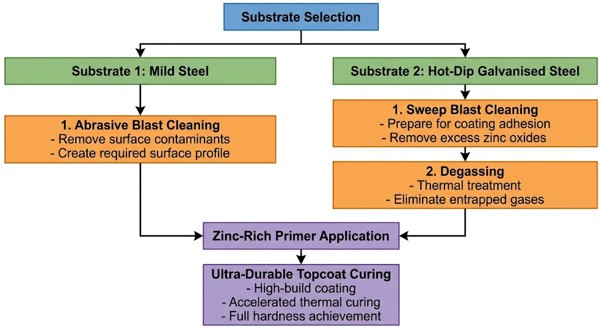
- Preparation: Heavy abrasive blasting to AS 1627.4 Class 2.5 is essential. This creates an anchor profile for powder adhesion.
Hot-Dip Galvanised (HDG) Steel
- Advantages: Offers dual protection through barrier containment and sacrificial zinc shielding.
- Corrosion Profile: Highly resistant to substrate rust propagation.
- Preparation: Requires specialised handling. Zinc surfaces passivate over time, creating smooth oxides that reduce powder adhesion.
To prevent adhesion failure on HDG steel, technicians execute a three-step pre-treatment process:
- Sweep Blasting: A light abrasive blast removes surface oxides without stripping the zinc layer.
- Degassing: The steel undergoes pre-heating in a high-temperature curing oven. This expels trapped air and moisture from the porous zinc coating, preventing pinholes and blisters during final curing.
- Chemical Pre-treatment: A conversion coat is applied to promote cross-link bonding between the zinc layer and the powder primer.
For heavy-duty structural applications, review our guide on Powder Coating Solutions Built for Demanding Industrial Use.
3. Powder Coating System Components: Primer & Topcoat Options
A marine-grade powder coating finish relies on a multi-layer protective system. Combining specialised primers with ultra-durable topcoats provides multi-layer atmospheric protection.
Protective Primer Systems
- Zinc-Rich Epoxy Primers: Act as a sacrificial barrier directly over bare blasted steel. They offer high cathodic protection against undercut corrosion if the topcoat is scratched.
- Non-Zinc Barrier Primers: Provide seal protection over zinc-rich or galvanised surfaces. They seal porous metal textures and prevent moisture ingress.
Performance Topcoat Chemistries
- Standard Architectural Polyester: Suitable for low-corrosion inland zones (C1–C2). Offers moderate UV resistance and colour retention.
- Super Durable Polyester: Formulated for moderate coastal regions (C3–C4). Resists UV degradation and gloss loss three times longer than standard polyesters.
- Fluoropolymer Topcoats: Designed for severe marine environments (C5/CX). Delivers maximum chemical resistance, chalk resistance, and colour retention.
4. Comparing Protective Systems for Coastal Shade Structures
The following table compares performance capabilities across standard industrial coating setups:
| Coating Feature / Metric | Standard Single-Coat Polyester | Two-Coat Zinc Primer + Super Durable | Duplex System (HDG + Epoxy Primer + Fluoropolymer) |
| Corrosion Zone Suitability | C1 – C2 (Inland Low Humidity) | C3 – C4 (Coastal / Urban High Humidity) | C5 – CX (Extreme Surf / Tidal Zones) |
| Expected Lifespan to First Maintenance | 3 to 7 Years | 10 to 15 Years | 20+ Years |
| UV & Chalk Resistance | Moderate | High | Maximum |
| Cathodic Cut Resistance | Low | High | Very High |
| Impact & Abrasion Tolerance | Moderate | High | Superior |
| Initial System Investment | Low | Moderate | High |
5. Specification Guidelines for Engineers, Architects & Developers
To ensure full compliance and long-term asset protection, structure project specifications using clear standards:
- Define Environmental ISO Category: Identify site classification (e.g., ISO 12944 Category C4 for marine coastal areas).
- Specify Surface Preparation: Mandate AS 1627.4 Class 2.5 abrasive blasting for raw steel or sweep blasting for HDG steel.
- Require Degassing Cycles: Mandate a thermal degassing cycle for all hot-dip galvanised structural members before powder coating.
- Mandate Accredited Applicators: Ensure powder application is performed by a Dulux or Interpon accredited applicator. Accredited applicators maintain strict quality control records, including film thickness testing, cross-hatch adhesion checks, and cure verification.
- Verify Large-Capacity Curing: Confirm that the powder coating facility operates an oven capable of accommodating full-length shade frames without sectioning.
Frequently Asked Questions
Can hot-dip galvanised steel be powder coated directly?
Yes, but it requires specific surface preparation. Galvanised steel must be sweep-blasted and thermally degassed before powder application. Skipping these steps can cause adhesion loss, blistering, or peeling.
What powder coating specification is required for coastal areas in Queensland?
Coastal projects within 1 kilometre of breaking surf require a two-coat or duplex powder system. This includes a zinc-rich epoxy primer topped with a Super Durable Polyester or Fluoropolymer topcoat, applied by an accredited facility.
Why does powder coating bubble or blister on galvanised shade structures?
Bubbling occurs when air or moisture trapped within the porous galvanised zinc layer expands during high-temperature oven curing. Conducting a pre-heating degassing cycle before spraying the powder eliminates trapped gases and prevents surface defects.
How does powder coating compare to traditional liquid paint for outdoor shade canopies?
Powder coating delivers superior impact resistance, edge coverage, and environmental safety compared to liquid paint. It cures without volatile organic compounds (VOCs) and forms a uniform protective shell that resists chipping, scratching, and UV fading.
How should commercial powder-coated shade structures be maintained in marine zones?
Structures located in coastal environments should be washed down with clean fresh water and a mild, non-abrasive detergent every three to six months. Regular cleaning removes accumulated salt deposits and pollutants, protecting the warranty and extending the coating’s service life.
