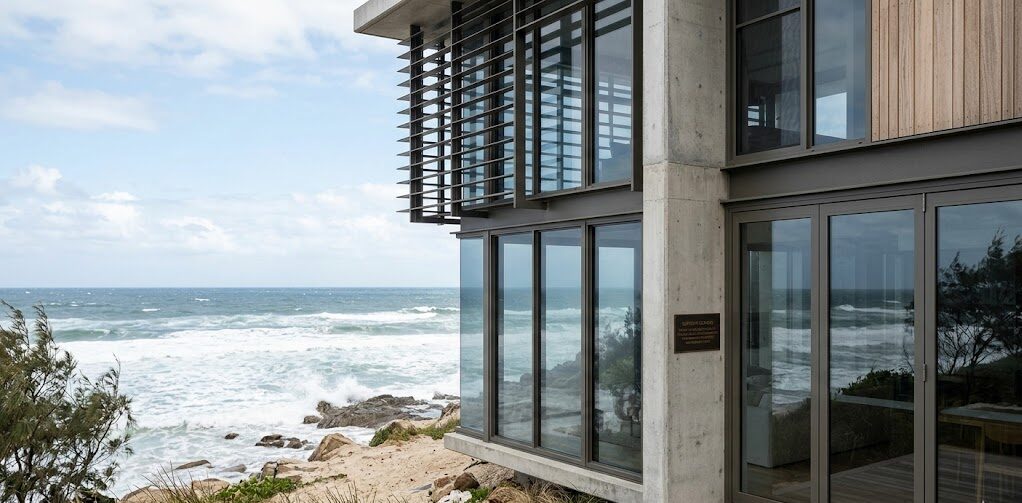
To appreciate why different regions of Brisbane require distinct powder coating strategies, we must look at the unique atmospheric corrosivity categories defined by Australian standards (AS4312).
The Coastal Threat: High Corrosivity (C4 to C5)
If your project sits within 5 kilometres of the coastline—or along the tidal reaches of the Brisbane River—it is constantly exposed to airborne marine salts. Sodium chloride particles settle on metal surfaces, attracting moisture even in relatively low humidity.
When sea salt combines with Brisbane’s sub-tropical warmth, it creates an aggressive electrochemical environment. If moisture penetrates a powder coating layer, it causes rapid filiform corrosion, leading to:
- Blistering and bubbling beneath the paint film.
- Complete adhesion failure, causing the coat to peel away in sheets.
- Rapid structural degradation of the underlying metal.
The Inland Threat: Medium Corrosivity (C3)
As you move inland toward areas like Logan, Forest Lake, or the CBD, the primary threats shift from marine salts to high UV radiation, seasonal humidity spikes, and urban micro-pollutants like vehicle emissions.
While the risk of severe salt-induced corrosion decreases, the intense Queensland sun poses a different danger. High UV exposure accelerates the degradation of low-grade polymer binders, resulting in:
- Severe colour fading and uneven patchiness.
- Loss of gloss, making vibrant buildings look dull.
- Chalking, which leaves a powdery surface residue that rubs off on contact.
Decoding AS3715: The Three Architectural Powder Tiers
The AS3715 standard specifies performance requirements for thermosetting powder coatings applied to aluminium architectural elements. It outlines strict testing protocols for atmospheric resistance, film thickness, adhesion, and impact resistance. Within this standard, the chemical formulation of the powder itself determines its ultimate performance tier.
[Class 1: Standard] —-> Ideal for Mild Inland (10-15 Yr Warranty)
[Class 2: Super Durable] -> Ideal for Commercial & Light Coastal (15-20 Yr Warranty)
[Class 3: Fluoropolymer] -> Ideal for Severe Marine & Monuments (20-30+ Yr Warranty)
1. Standard Durable Polyesters (Class 1)
These are the traditional workhorses of the residential market. They offer good all-around performance and are highly cost-effective for mild inland environments well away from salt influences. However, they are generally limited to a 10-to-15-year structural warranty and do not possess the UV stability or salt-spray resistance required for harsh coastal exposure.
2. Super Durable Polyesters (Class 2)
Formulated with advanced polyester resins and premium weathering pigments, Class 2 powders offer up to three times the UV resistance of standard polyesters. They serve as the baseline standard for commercial buildings, high-rise residential complexes, and moderate coastal environments, frequently carrying warranties up to 20 or 25 years.
3. Fluoropolymers (Class 3)
The pinnacle of coating technology, Class 3 fluoropolymers utilize hyper-stable chemical bonds that resist extreme UV radiation and severe chemical attacks. These premium coatings are explicitly reserved for landmark monumental projects, high-exposure public architecture, and severe coastal infrastructure.
The Strategic Blueprint: Location Mapping
When designing or fabricating for a Brisbane build, you can use this strategic framework to map your geographic location directly to the correct coating system:
| Project Location |
Atmospheric Classification |
Recommended AS3715 Powder Tier |
Required Pre-Treatment Protocol |
Minimum Warranty Target |
| Inland Suburbs
(e.g., Ipswich, Kenmore, Springwood) |
C3 (Medium) |
Standard or Super Durable
(Class 1 or 2) |
Standard Multi-Stage Chemical Clean |
10 – 15 Years |
| Urban / Light Coastal
(e.g., Brisbane CBD, Hamilton, Yeronga) |
C3 / C4 (Medium to High) |
Super Durable Polyester
(Class 2) |
Enhanced Conversion Coating or Chrome-Free Alternative |
15 – 20 Years |
| Severe Coastal / Bayside
(e.g., Wynnum, Redcliffe, Moreton Island) |
C4 / C5 (High to Very High) |
Super Durable Polyester (Class 2) or Fluoropolymer (Class 3) |
Heavy-Duty Acid Etch / Dual-Shield Primer System |
20 – 30+ Years |
Why Pre-Treatment is the Invisible Crux of Coastal Success
A common industry misconception is that a premium powder will automatically save a project from coastal corrosion. In reality, 90% of premature coating failures are caused by inadequate pre-treatment, not the powder itself. Even a Class 3 fluoropolymer will flake off if applied to an unconditioned, contaminated metal profile.
In coastal C4 and C5 environments, standard chemical cleaning is insufficient. To meet severe coastal warranty requirements under accredited frameworks, the metal must undergo an advanced, multi-stage conversion process:
- Acid or Alkaline Etching: This process strips away the naturally occurring, inconsistent aluminium oxide layer and removes surface contaminants embedded during fabrication.
- Conversion Coating: Applying a microscopic chemical barrier (such as a zirconium or chrome-based conversion layer) chemically locks the subsequent powder coat to the raw metal substrate.
- Flash Priming (Dual-Shield): For high-corrosion areas, applying a specialized epoxy primer coat beneath the architectural topcoat acts as a sacrificial barrier. This stops the spread of corrosion even if the outer layer is physically scratched or gouged.
The Ultimate Risk-Mitigation Strategy: Accreditation Matters
Specifying “Powder coating to AS3715” in your architectural drawings or fabrication tenders is only half the battle. If the applicator processing the metal does not hold formal, audited accreditations from major global powder manufacturers, your structural warranties may be completely null and void.
Global leaders like Dulux and
Interpon do not issue high-tier architectural warranties to standard jobbing shops. They restrict their commercial performance warranties exclusively to certified networks, such as Dulux Accredited Powder Coaters and
Interpon Approved Applicators.
Why Specified Accreditation Protects Your Project:
- Audited Pre-Treatment Lines: Certified coaters undergo regular, independent testing of their chemical tanks, rinse water purity, and oven baking profiles to ensure perfect cross-linking of the powder.
- Traceability: Every batch processed through an accredited line is logged with film-thickness testing and cross-hatch adhesion records, providing a legally binding warranty trail for builders and developers.
- Peace of Mind: If a failure occurs due to coating degradation under a qualified specification, both the powder manufacturer and the applicator stand behind the rectification framework.
Summary for Project Success
Before signing off on your next structural, facade, or framing package in Brisbane, ask your team these three screening questions to protect your investment:
- What is the exact distance to the nearest saltwater body? If it is under 5km, automatically upgrade from a Class 1 standard powder to a Class 2 Super Durable finish.
- Is the pre-treatment tailored for the microclimate? Ensure your fabrication partner knows that coastal projects require an enhanced etch or a dual-shield primer base.
- Is the powder coater independently certified? Protect your capital investment by ensuring your finishing provider holds the exact Dulux or Interpon accreditations required to sign off on architectural structural warranties.
By properly aligning your project’s physical location with the correct atmospheric tier of the AS3715 standard, you guarantee that your design remains as structurally sound and visually striking as the day it was installed. For more detailed technical specifications and local project consultations, you can visit
Superior Coaters.
 07 3375 6777