Can You Powder Coat Over Wet Paint? The Technical Guide

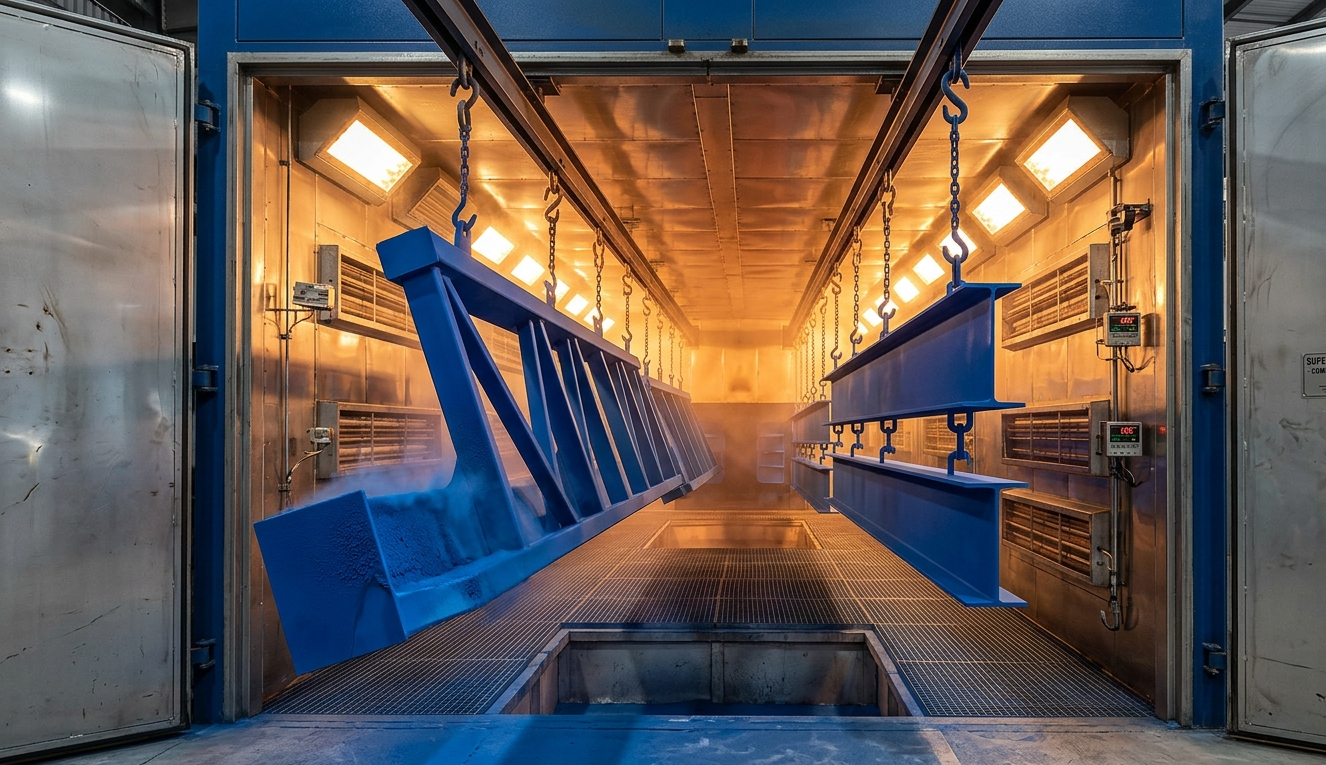
powder coating being baked onto Steel structure

For commercial project managers, structural engineers, and asset owners, specifying the correct protective coating is a critical factor in mitigating lifecycle costs and preventing catastrophic structural failure. When refurbishing existing industrial assets or managing complex fabrication workflows, a recurring technical question arises: Can you powder coat over wet paint?

The short answer is a definitive no. Attempting to apply an industrial powder coat directly over a pre-existing layer of traditional liquid paint is a practice that compromises aesthetic standards, degrades mechanical performance, and leads to premature corrosion.

As premier powder coating specialists, Superior Coaters has developed this technical guide to explain the chemical incompatibility of these systems, define industrial terminology, and outline the rigorous preparation standards required by professional powder coaters to guarantee maximum asset longevity.

Defining “Wet Paint” in Commercial Applications

In commercial manufacturing and heavy industry, the term “wet paint” (often used interchangeably with “liquid paint” or “liquid coatings”) does not simply refer to a coat of paint that is physically wet to the touch.

Instead, “wet paint” serves as a broad category classification for any traditional coating applied via fluid displacement—such as alkyd enamels, acrylic urethanes, lacquers, and multi-part epoxies—regardless of whether it is freshly sprayed, fully cured, or decades old.

While liquid coatings have distinct roles in field-applied maintenance, their basic chemical formulation relies on volatile solvents and organic polymers that behave unpredictably when subjected to the thermal profile of an industrial powder coating infrastructure.

The Science of Thermal Degradation: Why Liquid Coatings Fail

To understand why powder coatings cannot be applied over a liquid “wet paint” substrate—even one that has been fully cured for years—one must examine the physics of the electrostatic baking process.

Unlike liquid coatings that cure via solvent evaporation or atmospheric cross-linking at ambient temperatures, powder coating is a completely dry, thermal-fusion process. It involves applying electrostatically charged pigment and resin particles to a grounded metal substrate, which is then moved into a specialized curing oven operating between 180°C and 200°C.

Introducing an asset coated in liquid paint to this environment triggers three critical failure mechanisms:

1. Thermal Outgassing and Volatilization

Traditional liquid coatings are not formulated to withstand sustained exposure to 200°C heat. At these elevated temperatures, the organic binders within the old liquid paint thermally degrade. Any trapped solvents, chemical plasticizers, or microscopic moisture deep within the film vaporize rapidly. As these gases expand, they force their way upward through the melting powder layer, causing severe bubbling, cratering, and microscopic pinholes that compromise the seal of the final finish.

2. Disruption of Electrostatic Adhesion

Industrial powder application relies on a flawless electrical ground connection between the spray gun and the raw metal. Liquid paint acts as a powerful dielectric insulator. By interrupting the path to ground, an underlying paint layer prevents the dry powder particles from adhering uniformly during application, resulting in severe sagging, uneven film thickness, or a complete failure of the powder to cling to the asset.

3. Total Intercoat Delamination

Even if a powder layer appears to fuse successfully over a liquid primer or topcoat, the mechanical bond is fundamentally flawed. The powder cannot achieve a direct anchor pattern with the metal pores; it merely adheres to the structurally inferior liquid paint beneath it. As the oven heat weakens the underlying paint layer, the entire system loses cohesive strength. Under physical stress or thermal cycling, the powder coating will delaminate in large sheets, leading to localized corrosion cells and rapid asset degradation.

Industrial Surface Preparation Standards

For heavy industries and infrastructure builders, shortcutting the preparation phase defeats the purpose of selecting industrial coatings. To transition an existing asset safely from a liquid coating to a premium powder finish, the metal must undergo a complete multi-stage remediation process.

[Industrial Metal Asset] ➔ [Abrasive Blast Cleaning] ➔ [Chemical Conversion Wash] ➔ [Electrostatic Powder Spray] ➔ [Oven Curing (200°C)]

At Superior Coaters, our high-volume industrial powder coating services rely on a strict pre-treatment protocol:

Abrasive Blasting (Sandblasting): Mechanical blasting completely strips away old liquid paint, mill scale, and heavy corrosion. This process purifies the substrate while creating a specific anchor profile (surface roughness) essential for mechanical adhesion.

Chemical Conversion Pre-treatment: Following abrasive blasting, components are chemically treated to remove micro-contaminants, passivate the metal surface, and provide an optimized foundation for the powder matrix.

Structural Specification: Protecting Public and Commercial Infrastructure

When deploying structural elements into highly corrosive environments, matching proper metal preparation with global-standard architectural powders ensures decades of operational service.

Public Utilities, Assets, and Light Poles

Assets placed in public spaces face relentless mechanical impacts, environmental pollutants, and high-traffic wear. Procurement officers require industrial partners with specialized technical capability. Superior Coaters serves as a trusted provider of Brisbane powder coaters for street poles, delivering the specialized powder coating service light poles require to withstand intensive long-term weathering. Managing these contracts requires an industrial powder coating service with large ovens configured to process large-scale structural sections uniformly without introducing thermal warping.

Heavy Bridges and Commercial Shade Structures

On large-scale infrastructure projects involving powder coater bridge components or heavy powder coaters bridges, coating failures carry extreme liability. Intercoat delamination on a bridge assembly requires expensive field remediation and introduces critical corrosion risks to structural load points.

Similarly, developers and civil contractors rely heavily on heavy-duty powder coaters shade structures to protect transit hubs, retail plazas, and educational facilities. Partnering with localized infrastructure specialists—whether coordinating with powder coaters shade structures Rocklea for localized fabrication pipelines or establishing a broad powder coaters shade structures Brisbane logistical strategy—ensures all structural frameworks receive verified, commercial-grade protection capable of resisting intense UV chalking.

Commercial Sector

Component Examples

Core Performance Requirement

Civil Transport & Utilities

Street light poles, gantries, traffic frames

High impact resistance, anti-marring, chemical resistance

Structural Engineering

Bridge walkways, structural beams, handrails

High-build barrier protection, zero-delamination guarantees

Commercial Construction

Architectural shade sails, awnings, external louvres

Superior UV stability, color retention, gloss retention

Agricultural Logistics

Grain hoppers, storage silos, material chutes

High abrasion resistance, smooth material flow friction

Furthermore, utilizing robust powder coating for grain hoppers protects transport assets against severe abrasion from bulk material movement while preventing corrosion from organic chemical contact.

The Advantages of Commercial-Grade Powder Systems

When managed correctly by an accredited powder coater in Brisbane, shifting commercial asset specifications from traditional liquid paints to an advanced powder system provides measurable performance returns:

Verified Material Compliance: Working alongside a Dulux accredited powder coaters Brisbane facility or specifying an Interpon accredited powder coating system ensures that your structural assets are backed by field-tested, globally recognized warranties engineered for harsh marine and high-UV exposures.

Advanced Marine Layering: For infrastructure deployed near coastal environments, integrating a duplex system—such as a hot dip galvanised steel powder coating or a powder coating galv steel Brisbane specialty primer application—yields a highly durable barrier that stops rust tracking in its tracks.

Reduced Environmental Liability: Powder coatings are inherently free of volatile organic compounds (VOCs). Transitioning away from liquid coatings eliminates hazardous waste disposal costs and helps projects meet modern green building and environmental sustainability benchmarks.

Secure Your Commercial Coating Pipeline

If your structural project features existing specifications based on old liquid paint, do not risk field failures by applying coatings over compromised substrates. Entrust your assets to a professional commercial powder coating service equipped to handle complete coating extraction, precision substrate preparation, and advanced thermal application.

Superior Coaters manages complex, large scale powder coating configurations within our streamlined Queensland facility. From mass-production manufacturing runs to bespoke civil engineering infrastructure, our industrial team supplies the protective metal finishes Brisbane contractors count on to preserve capital assets.

Partner with an established team of powder coating specialists. Contact Superior Coaters today to integrate our abrasive blasting, chemical pre-treatment, and high-durability powder coating capabilities into your next commercial procurement cycle.