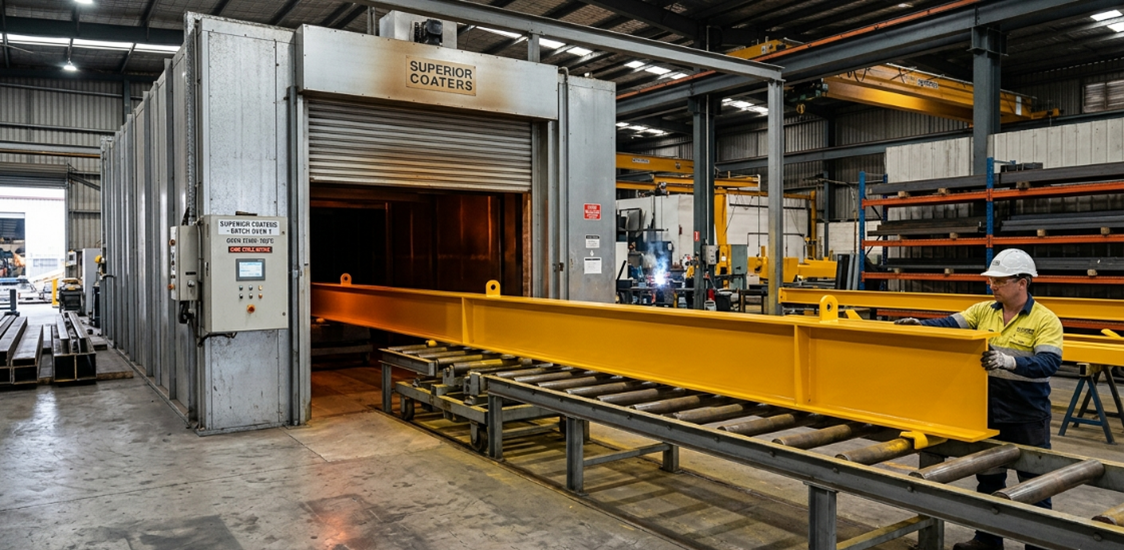
Structural engineers, commercial steel fabricators, and project managers often face a choice during drafting: section large steel components or coat them as a single continuous piece.
Artificially splitting or sectioning large steel members solely to fit standard coating ovens is known as the
“Splicing Trap.” While splicing solves short-term processing constraints, it creates severe long-term engineering, logistical, and financial liabilities.
Designing for continuous, single-piece powder coating using ultra-large-capacity batch ovens removes these risks and provides superior corrosion protection.
What is the Splicing Trap?
The
Splicing Trap occurs when a designer or engineer adds unnecessary bolted or welded joints to structural steel purely because local coating facilities cannot fit the full-length component.
- Standard Batch Ovens: Most commercial facilities cap out at 6 to 8 meters.
- Common Monolithic Components: Infrastructure projects regularly require 10-to-14-meter components like portal frames, high-mast lighting columns, transport chassis, and architectural facades.
- The Forced Result: Fabricators split 11m to 13m members into multiple sections, coat them separately, and reconnect them on-site.
Engineering Vulnerabilities of Spliced Steel
Adding joints to a monolithic steel structure creates continuous points of vulnerability:
- Stress Concentrations: Bolted splice plates create localized stress points around bolt holes. These areas are prone to fatigue from dynamic loads like wind or transit vibrations.
- Crevice Corrosion: Mating steel plates leave micro-gaps. Capillary action draws in moisture, salts, and contaminants. Lower oxygen inside the gap forms a differential aeration cell, accelerating hidden rusting.
- Coating Damage During Assembly: Torquing heavy structural bolts during site assembly chips and cracks the surrounding powder coat, exposing raw steel.
- Inadequate Touch-Ups: Field-applied liquid paint over assembly damage lacks the density, dry film thickness (DFT), and cross-linked adhesion of factory-cured powder coating.
Cost Analysis: Spliced vs. Continuous Coating
Designing for continuous 14-meter batch curing significantly lowers project costs and site labour compared to splicing.
| Project Metric |
Spliced Design (2x 6m Sections) |
Continuous Design (1x 12m Section) |
| Fabrication Labor |
High (Detailing, cutting, drilling splice plates, extra welding) |
Low (Straight cut, standard end preparation) |
| Component Count |
High (2 beams, 2 splice plates, multiple bolts and washers) |
Minimal (1 single beam) |
| Crane & Rigging Time |
Doubled (Holding two pieces during alignment) |
Halved (Single lift into final position) |
| Site Labor Hours |
High (Alignment, bolt torquing, liquid paint touch-ups) |
Low (Fast securement, zero site coating required) |
| Long-Term Maintenance |
High (Requires periodic joint inspections and re-coating) |
Minimal (Uniform weathering across the asset) |
Export to Sheets
Benefits of 14-Meter Continuous Batch Curing
Utilizing a specialist
commercial powder coating facility with a 14-meter cure oven offers clear structural and financial advantages:
- Uniform Dry Film Thickness (DFT): Processing full-length pieces end-to-end eliminates colour and coating variance across batches.
- Unbroken Corrosion Barrier: Eliminates splice plates and fasteners, providing uninterrupted protection against harsh airborne chlorides.
- Full Warranty Compliance: Meets Australian Standards like AS/NZS 4506. Avoids jeopardizing 20-to-25-year commercial warranties from major suppliers like Dulux and Interpon due to site modifications.
Learn more about
working at scale with 14-metre powder coating or explore our guides on
powder coating hot-dip galvanized steel and
Dulux accreditation standards.
Frequently Asked Questions (FAQ)
1. What is the “Splicing Trap” in structural steel design?
The Splicing Trap refers to artificially sectioning steel components into smaller pieces purely to fit inside small powder coating ovens. This practice creates weak joints, increases labour costs, and breaks the protective corrosion barrier.
2. How does splicing structural steel increase corrosion risks?
Splicing introduces micro-gaps between mating surfaces that trap moisture and salts, causing crevice corrosion. Additionally, bolting sections together on-site damages the factory powder coat finish, exposing raw steel to the elements.
3. What are the size limitations of standard powder coating facilities?
Most standard commercial powder coaters operate batch ovens that max out at 6 to 8 meters in length. Oversized batch curing facilities can handle continuous spans up to 14 meters.
4. How does continuous coating affect commercial paint warranties?
Continuous coating ensures full compliance with standards like AS/NZS 4506. Site-welding or bolting coated steel often invalidates premium 20-to-25-year warranties provided by manufacturers like Dulux or Interpon due to damaged coatings at the joints.
5. Does single-piece powder coating cost more than splicing steel?
No. While large-capacity coating may seem specialized, continuous single-piece designs reduce total project costs by eliminating extra fabrication labour, splice plate hardware, extended crane time, and ongoing joint maintenance.
 07 3375 6777