Key Takeaways
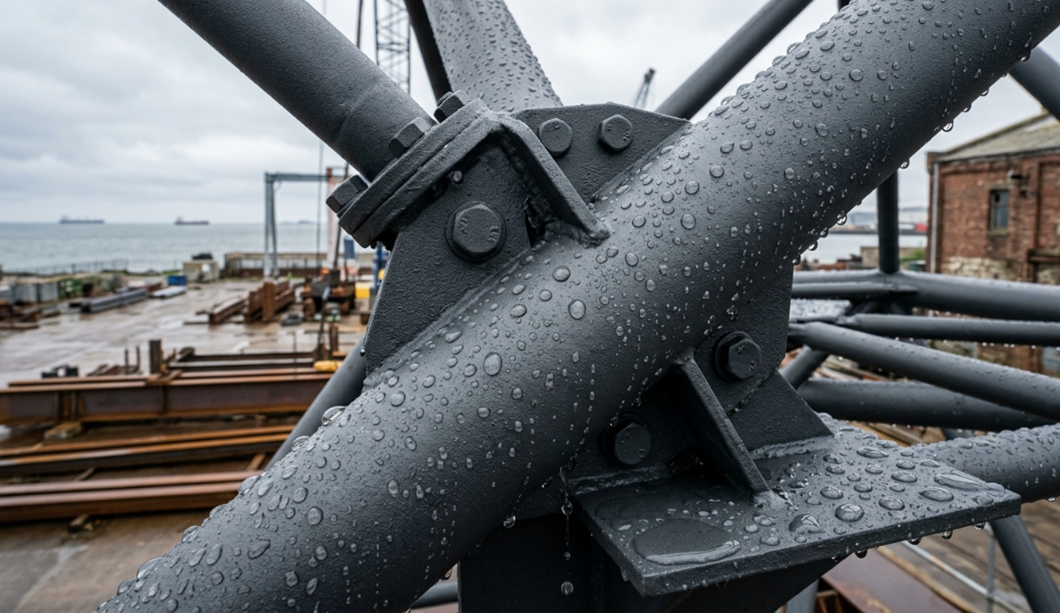
- Beyond Barrier Protection: Super-hydrophobic surfaces (SHS) actively reject moisture instead of relying solely on physical barriers.
- The Lotus Effect: Microscopic and nanoscopic structures trap air beneath water droplets, preventing direct contact with the surface.
- Cassie–Baxter Model: Water droplets rest on a cushion of air, reducing solid-to-liquid contact by up to 95%.
- Lower Lifecycle Costs: Preventing electrolyte contact extends maintenance intervals and reduces structural repairs.
What is Super-Hydrophobic Coating Technology?
Traditional anti-corrosion methods shield steel and aluminium with paint or standard powder coating. However, micro-scratches or chips allow water to penetrate, triggering unseen galvanic and crevice corrosion.
Super-Hydrophobic Surfaces (SHS) represent a modern shift in surface engineering. Rather than simply blocking water, SHS alters surface topography at microscopic levels to make liquids bead up and roll off instantly.
The Science: Understanding Surface Wettability
Surface wettability is measured using the
Water Contact Angle (WCA):
- Hydrophilic Surfaces: Water spreads flat with a contact angle under 90°.
- Hydrophobic Surfaces: Water beads up slightly with a contact angle between 90° and 150°.
- Super-Hydrophobic Surfaces: Water forms near-perfect spheres with a contact angle exceeding 150° and a sliding angle below 10°.
The Cassie–Baxter Wettability Model
Super-hydrophobic powder coatings mimic the natural structure of lotus leaves:
- The coating cures into a dual-scale micro- and nano-structured roughness.
- Moisture cannot penetrate the microscopic grooves.
- Air becomes trapped in the valleys beneath the droplet, creating an air plastron (a protective air cushion).
- Liquid rests on tiny nanostructures, reducing direct surface contact area by up to 95%.
- Water rolls off at the slightest angle, taking surface contaminants with it.
Surface Performance Comparison
| Surface Type |
Water Contact Angle |
Droplet Behaviour |
Contact Area Reduction |
Corrosion Risk |
| Hydrophilic |
< 90° |
Spreads completely flat |
0% |
Very High |
| Hydrophobic |
90° to 150° |
Beads up partially |
Moderate |
Moderate |
| Super-Hydrophobic |
> 150° |
Forms perfect spheres |
Up to 95% |
Extremely Low |
How Super-Hydrophobic Coatings Block Corrosion
Corrosion requires three components: an anode, a cathode, and an electrolyte (such as salty or polluted moisture). Removing the electrolyte prevents the electrochemical reaction.
Super-hydrophobic coatings stop corrosion using three primary mechanisms:
- Electrolyte Elimination: Moisture sheds instantly. Water films cannot stagnate on the metal surface.
- Salt and Ion Isolation: Trapped air cushions block airborne chlorides and atmospheric pollutants from contacting the substrate.
- Capillary Pressure Resistance: Microscopic surface geometry creates outward pressure, keeping water out of tiny surface pores.
Practical Applications
- Coastal Architecture: Shields architectural extrusions and window frames from harsh marine spray.
- Commercial Logistics: Protects vehicle chassis, transport frames, and shipping containers against road salt and weathering.
- Industrial Facilities: Defends chemical processing plants and treatment facilities against humid, corrosive atmospheres.
Frequently Asked Questions (FAQs)
1. How does super-hydrophobic coating differ from traditional powder coating?
Traditional coatings create a physical barrier to keep water out. If scratched, moisture gets under the barrier and causes rust. Super-hydrophobic coatings actively repel water at a microscopic level, creating an air cushion that prevents water from contacting the metal.
2. What is the “Lotus Effect” in material science?
The Lotus Effect refers to natural self-cleaning properties observed in lotus leaves. Microscopic bumps on the leaf surface prevent water from spreading. Instead, water forms spherical drops that roll off, collecting dirt and debris along the way.
3. Can super-hydrophobic coatings protect metal in coastal environments?
Yes. Coastal air contains high concentrations of salt ions that accelerate metal breakdown. Super-hydrophobic coatings create an air layer that stops saline water droplets from resting on the surface, drastically lowering salt-induced corrosion.
4. How do super-hydrophobic coatings reduce long-term maintenance costs?
Because these coatings reject moisture and prevent micro-corrosion beneath the surface, treated assets require fewer inspections, repairs, and recoating treatments. This significantly lowers overall asset lifecycle costs.
5. What is an air plastron and why is it important?
An air plastron is a microscopic layer of air trapped in the valleys between nanostructures on a super-hydrophobic surface. It acts as a physical barrier that stops liquid water and dissolved chemicals from directly touching the underlying metal substrate.
 07 3375 6777