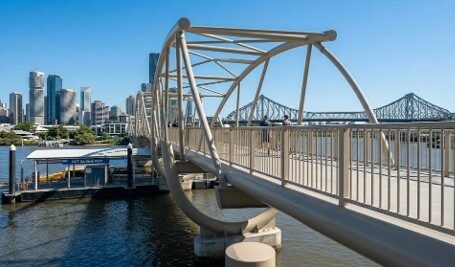
Specifying metal finishes for public infrastructure across Southeast Queensland requires high durability, strict regulatory compliance, and proven long-term performance. Public assets like bridges, transit hubs, and shade structures face continuous UV exposure, severe weather, heavy foot traffic, and salt spray.
Selecting compliant powder coating systems protects community safety, extends asset lifespans, and safeguards public funds.
Why Compliance Matters in Public Infrastructure
Standard commercial paint finishes are insufficient for structural steel and aluminium assets. Civil projects require industrial-grade powder coating systems backed by verified quality assurance.
- Asset Longevity: Extends the functional lifespan of metal infrastructure by decades.
- Reduced Maintenance: Eliminates the need for costly, ongoing on-site repainting.
- Public Safety: Prevents structural degradation and corrosion-induced failure.
- Aesthetic Retention: Resists extreme UV degradation, chalking, and graffiti attempts.
To review certified local application standards, learn more
about our Brisbane powder coating facility.
AS1530 Fire Performance Standards Explained
Fire safety is mandatory for materials specified in transit hubs, high-density public areas, and commercial construction. Australian Standard AS1530 regulates fire testing methods for building components.
- AS1530.1: Evaluates the core non-combustibility of materials.
- AS1530.3: Tests simultaneous early fire hazard properties (ignitability, flame propagation, heat release, and smoke release).
Certified powder coatings applied by accredited specialists deliver a sleek finish without introducing fire hazards to structural assets.
Duplex Systems: Hot Dip Galvanised Steel + Powder Coating
A duplex coating system combines a hot dip galvanised steel base with a high-performance powder topcoat. This combination provides synergistic protection, lasting up to
2.5 times longer than either system used independently.
Key Processing Requirements:
- Mechanical Profiling: Prepares the zinc-iron alloy layer for optimal powder adhesion.
- Degassing Bake: Expels trapped gases prior to coating to prevent pinholes and blistering.
- Barrier & Galvanic Defence: Combines sacrificial zinc protection with a chemical-resistant outer barrier.
For detailed application guidelines on structural steel, view our
architectural specifier’s guide for structural galvanised steel.
Structural Bridge Components & Coastal Protection
Infrastructure in South East Queensland faces intense environmental stress. Coastal salt spray accelerates filiform and galvanic corrosion on raw metals.
Specialized Protection Features:
- Edge Coverage: Specialized techniques ensure full micron thickness over sharp edges and welds.
- Vibration Flexibility: Flexible topcoats accommodate micro-movements and bridge vibrations without cracking.
- Impact Resistance: Deflects road debris, gravel, and mechanical abrasion.
- Multi-Stage Pre-Treatment: Chemical cleaning steps remove microscopic surface salts before coating.
For coastal assets, explore our specialized solutions for
coastal powder coating protection. For large-scale projects, discover how we handle high-capacity orders through our
14-metre powder coating infrastructure logistics.
Infrastructure Finish Comparison Matrix
| Feature / Standard |
Standard Commercial Paint |
Standard Powder Coating |
Duplex Powder Coating (Galvanised + Powder) |
| Primary Environment |
Light Commercial / Low Stress |
General Architectural |
Heavy Civil / Coastal / High Traffic |
| AS1530 Compliance |
Varies / Limited |
Certified |
Certified |
| Corrosion Resistance |
Low to Moderate |
High |
Extreme (Synergistic) |
| Lifespan Expectancy |
3–5 Years |
10–15 Years |
Up to 30+ Years |
| Impact & UV Resistance |
Low |
Very High |
Premium Grade |
| Warranty Support |
Basic |
Standard Commercial |
Up to 30-Year Structural Warranty |
Accredited Applicators & Project Warranties
Using high-grade powder products (such as AkzoNobel Interpon or Dulux) requires application by an accredited specialist to validate structural warranties.
- Audited Quality Control: Ensures accurate chemical pre-treatment and curing temperatures.
- Verified Micron Thickness: Guarantees film thickness meets engineering specifications.
- Long-Term Warranties: Unlocks commercial warranties of up to 30 years.
Read our complete breakdown of
Dulux accreditation and 20-year commercial warranties or consult our guide on
specifying powder coating for shade structures.
Infrastructure Compliance Checklist
| Requirement |
Audit standard |
Primary Purpose |
| Fire Safety |
AS1530.1 & AS1530.3 Certified |
Ensures public safety in enclosed public hubs |
| Accreditation |
Dulux / Interpon Accredited Applicator |
Unlocks long-term commercial structural warranties |
| Pre-Treatment |
Multi-Stage Chemical Clean |
Prevents premature peeling, blistering, and corrosion |
| Oven Capacity |
Industrial Large-Batch Baking |
Accommodates oversized civil assets in seamless runs |
To discuss specification requirements for your upcoming civil project, explore
our commercial services or
contact our Brisbane team.
Frequently Asked Questions (FAQs)
1. What is AS1530 compliance and why is it required for powder coating?
AS1530 is the Australian Standard for fire testing on building materials and structures. AS1530.1 tests non-combustibility, while AS1530.3 evaluates early fire hazards like ignitability, flame spread, and smoke release. Compliance ensures powder-coated architectural metalwork does not contribute to fire hazards in public spaces.
2. What is a duplex coating system?
A duplex coating system combines hot dip galvanised steel with an overcoat of high-performance powder coating. This combination creates a synergistic effect that protects steel up to 2.5 times longer than hot dip galvanising or powder coating used on its own.
3. Why is degassing necessary when powder coating galvanised steel?
Hot dip galvanised steel can trap air and gases within its porous zinc layer. During the high-temperature curing process in the oven, these trapped gases expand and escape, creating pinholes or blisters in the powder finish. Pre-baking (degassing) the steel drives out these gases before applying the powder layer.
4. Why must I use an accredited applicator for civil tenders?
Global powder suppliers like Dulux and Interpon only issue extended commercial structural warranties (up to 30 years) if the coating is applied by an audited, accredited facility. Accreditation verifies that chemical pre-treatment, curing oven temperatures, and micron film thickness meet strict international standards.
5. How does powder coating withstand coastal marine environments in Queensland?
Coastal marine environments contain high airborne salt concentrations that accelerate corrosion. High-performance coastal powder coating systems use multi-stage chemical pre-treatments to strip microscopic salts, followed by
corrosion-resistant primers and UV-stable topcoats that seal the metal from moisture and oxygen.
 07 3375 6777