 07 3375 6777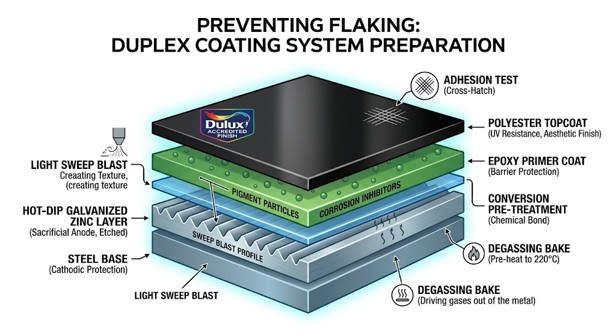
Powder coating over hot-dip galvanized steel is known in the architectural and industrial sectors as a duplex coating system. When executed correctly, a duplex system delivers exceptional corrosion protection. It combines the sacrificial cathodic protection of zinc with the barrier protection and aesthetic versatility of a powder coating finish.
However, applying powder coat directly onto hot-dip galvanized steel without precise surface preparation is a recipe for failure. Common issues include adhesion loss, blistering, pin holing, and widespread flaking.
This guide outlines the technical process required to prepare and powder coat hot-dip galvanized steel to ensure long-term durability and full compliance with Australian standards.
Why Powder Coating Galvanized Steel Fails
Applying a powder coat to freshly galvanized steel creates unique metallurgical challenges:
- Surface Smoothness & Contaminants: Hot-dip galvanizing creates an ultra-smooth, non-porous layer of zinc. Without mechanical profiling, powder coatings cannot achieve an adequate mechanical interlock.
- Zinc Oxidation (White Rust): Galvanized steel reacts rapidly with atmospheric oxygen and moisture, forming zinc hydroxide and zinc carbonate (white rust). Powder coating over this film leads to rapid delamination.
- Outgassing (Pinholing): Galvanized steel traps small pockets of air, moisture, and hydrogen during the pickling and dipping process. When heated in a powder coating curing oven, these trapped gases expand, venting through the molten powder and leaving microscopic pinholes or craters.
Step-by-Step Preparation & Coating Process
To achieve maximum adhesion and prevent film defects, applicators must follow a rigorous multi-stage preparation process.
Stage 1: Degreasing & Cleaning
The galvanized surface must be completely free of oils, grease, soluble salts, and quenching chemicals.
- Alkaline or solvent washing is used to strip surface oil and contaminants.
- High-pressure water rinsing removes residual cleaning agents and loose surface salts.
Stage 2: Mechanical Profiling (Sweep Blasting)
Standard grit blasting will strip the zinc coating off the steel base. Instead, sweep blasting (light whip blasting) is required to etch the surface without removing the protective zinc layer.
- Abrasive Media: Fine, non-metallic media such as aluminium oxide or garnet (size 0.2–0.5 mm).
- Blasting Angle: Maintained at 30° to 45° relative to the surface.
- Pressure: Kept low, typically between 30 to 40 psi (200–275 kPa).
- Objective: Create a uniform anchor profile of 15–25 microns while preserving the underlying galvanized coating.
Stage 3: Degassing Bake
Outgassing is the leading cause of pinholes in duplex systems. A degassing heat cycle drives out entrapped gases before applying the coating.
- Place the sweep-blasted steel into the pre-heat oven.
- Heat the component to a temperature 10°C to 15°C higher than the final powder curing temperature (typically 210°C–220°C).
- Hold at peak temperature for 15 to 30 minutes, depending on the steel mass, to exhaust trapped moisture and air.
Stage 4: Conversion Coating & Chromate-Free Pre-treatment
After cooling, apply an appropriate chemical pre-treatment (such as a silane, zirconium, or zinc-phosphate conversion coating). This chemical layer enhances corrosion resistance and creates a chemical bond between the zinc substrate and the powder layer.
Stage 5: Application & Curing
Apply an architectural-grade epoxy or polyester powder coat. For maximum durability in harsh Australian coastal environments, a two-coat system (epoxy zinc-compatible primer followed by an architectural polyester topcoat) is recommended. Curing must follow the powder manufacturer’s specified time and temperature profile precisely.
Comparing Substrate Preparation Methods
Choosing the correct surface preparation method is crucial for long-term coating adhesion. The table below compares common approaches:
|
Preparation Method |
Surface Profile Created |
Risk of Zinc Damage |
Outgassing Prevention |
Suitable for Duplex Systems? |
|
Direct Application (No Prep) |
None (Smooth Zinc) |
None |
None |
No — High risk of total flaking |
|
Acid Etch Wash |
Very Low |
Minimal |
None |
Conditional — Light structural use only |
|
Heavy Abrasive Blasting |
Deep (>50 microns) |
High (Removes Zinc) |
Low |
No — Destroys galvanized layer |
|
Sweep Blasting + Degassing Bake |
Ideal (15–25 microns) |
Very Low |
Very High |
Yes — Industrial & architectural standard |
Compliance with Australian Standards
Industrial and commercial projects across Queensland and Australia require strict adherence to standard guidelines to qualify for project warranties:
- AS/NZS 4506: Metal finishing — Thermoset powder coatings for corrosion protection of atmospheric categories.
- AS/NZS 4680: Hot-dip galvanized (zinc) coatings on fabricated ferrous articles.
- AS 3715: Metal finishing — Thermoset powder coatings for architectural applications.
Utilizing a certified, accredited applicator ensures that film thickness tests, crosshatch adhesion tests, and curing checks are performed and logged in accordance with these standards.
Frequently Asked Questions
1. Why does powder coat flake off galvanized steel after a few months?
Flaking occurs primarily due to poor surface preparation. If white rust (zinc carbonate) or oils are left on the steel, or if the smooth zinc layer is not textured via sweep blasting, the powder coat cannot form a mechanical or chemical bond with the substrate. Over time, environmental exposure causes complete adhesion loss.
2. What is outgassing and how does it affect powder coating?
Outgassing happens when air, moisture, or chemical residues trapped within the porous galvanized zinc layer expand during the high-heat curing process. As these gases escape through the molten powder coating, they leave visible pinholes, bubbles, or craters in the finished surface.
3. Can you powder coat old or weathered galvanized steel?
Yes, but weathered galvanized steel requires thorough cleaning. Over time, galvanized steel develops a heavy layer of zinc carbonates and potential surface contamination. The surface must be thoroughly degreased, pressure washed and lightly sweep-blasted to remove all oxidation products down to sound zinc before powder coating.
4. Is a primer necessary when powder coating over hot-dip galvanized steel?
While a single coat of polyester powder can adhere to correctly prepared galvanized steel, an epoxy primer coat is strongly recommended for aggressive environments (such as coastal or industrial locations in Queensland). A two-coat system (epoxy primer + topcoat) provides a secondary barrier that significantly extends the lifespan of the duplex coating.
5. How does sweep blasting differ from standard sandblasting?
Standard sandblasting uses high pressure (80–100 psi) and coarse abrasive media to strip rust and scale, which would strip away the protective zinc coating on galvanized steel. Sweep blasting uses low pressure (30–40 psi), fine non-metallic media, and an angled spray pattern to etch the surface gently without removing the zinc substrate beneath.
