 07 3375 6777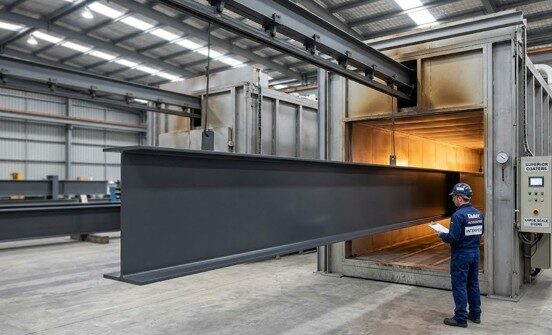
Selecting the right protective coating for commercial steelwork impacts your budget and project timeline. Commercial tier-1 builders, estimators, and steel fabricators across Australia face a key choice: powder coating vs. liquid painting.
Both systems offer corrosion protection for structural steel, light poles, and shade frames. However, their cost profiles differ significantly. Understanding upfront application expenses, transport logistics, and long-term maintenance costs helps ensure project profitability.
1. Upfront Material and Application Costs
Upfront cost involves more than the price per litre or kilogram of coating material. It includes surface preparation, labour hours, and shop application efficiency.
Surface Preparation Requirements
- Powder Coating: Demands rigorous pre-treatment. Steel components undergo abrasive blasting and multi-stage chemical washing to achieve standard-compliant adhesion.
- Liquid Paint: Requires similar abrasive blasting for high-performance marine or industrial specification coats. Lower-grade applications may use manual wire-brushing, though this reduces service life.
Application Efficiency and Labor
- Powder Coating: Applied electrostatically in a single pass. Over-sprayed powder is reclaimed and reused, resulting in less than 5% material waste.
- Liquid Painting: Requires multiple coats (primer, intermediate epoxy, and polyurethane topcoat). Each layer requires labour-intensive setup, spraying, and inspection. Overspray waste often ranges between 30% and 50%.
Key Cost Takeaway: Powder coating has higher initial setup costs for small runs. However, for volume components, single-pass processing significantly reduces labour hours per square metre.
2. Speed, Handling, and Turnaround Logistics
Time on site translates directly to project expenditure. Turnaround time in the shop influences crane hire, site assembly schedules, and holding costs.
- Curing Speed: Powder coating bakes and cures inside large industrial ovens within minutes of application. Once cool, components are ready for packing and transport. Liquid paint systems require hours—or days—of ambient drying between coats.
- Handling and Site Damage: Cured powder coatings create a tough, flexible finish highly resistant to chipping during transit. Liquid paint remains vulnerable to scratching during strapping and transport, often requiring costly site touch-ups.
- Weather Disruptions: On-site wet painting depends heavily on ambient humidity and temperature. Shop-applied powder coating maintains a controlled climate inside the facility, eliminating weather-related project delays.
For projects featuring extra-large structural elements, accessing facilities with large-capacity powder coating ovens allows heavy-duty steel to be processed quickly without requiring multi-coat wet painting.
3. Cost Comparison Matrix
The table below outlines the core differences between factory powder coating and traditional liquid painting systems for commercial applications.
|
Cost & Operational Factor |
Industrial Powder Coating |
Commercial Liquid Painting |
|
Material Utilization Rate |
Very High (up to 98% via powder reclamation) |
Moderate to Low (30%–50% lost to overspray) |
|
Labor Intensity |
Low–Moderate (Single-pass electrostatic coat) |
High (Multi-coat application + drying wait times) |
|
Curing & Handling Time |
Fast (Immediate oven cure, ready to transport) |
Slow (24–72 hours total dry time between coats) |
|
Transit Scratch Resistance |
High (Durable, chip-resistant barrier) |
Moderate (Prone to transport scuffs and site touch-ups) |
|
Environmental Compliance |
High (Zero VOCs, no hazardous chemical waste) |
Lower (High VOC emissions, solvents require disposal) |
|
Long-Term Lifecycle Cost |
Low (Minimal maintenance required over 15–25 years) |
Moderate–High (Requires recoating cycles every 7–10 years) |
4. Lifecycle Maintenance and Environmental Impact
Evaluating coating costs over a 20-year operational period highlights true project expenditure.
Maintenance Cycles
- Liquid Paint: Environmental exposure causes liquid paint films to chalk, crack, and micro-flake over time. Commercial structures typically need localized recoating every 7 to 10 years.
- Powder Coating: Premium formulations engineered for high-UV Australian conditions retain colour stability and corrosion resistance for decades.
Compliance and Environmental Expenses
- Liquid paints contain Volatile Organic Compounds (VOCs) and solvents. Disposing of hazardous paint waste incur environmental compliance fees.
- Powder coating contains no solvents and emits negligible VOCs. This simplifies environmental reporting and supports green building credits on major infrastructure contracts.
When planning outdoor installations like urban furniture or shade canopies, specifying finishes designed for outdoor shade structures and urban infrastructure protects against coastal atmospheric corrosion while avoiding ongoing repair costs.
Frequently Asked Questions
1. Is powder coating always cheaper than liquid painting for structural steel?
For volume production, light poles, and repeat components, powder coating is generally more cost-effective due to lower labour requirements and material efficiency. For single, ultra-large steel members that exceed oven dimensions, liquid painting may be the only practical choice.
2. How do transport and handling costs compare between the two methods?
Powder coating forms a harder, impact-resistant shield during oven curing. This reduces transport damage, saving money on touch-up labour and equipment downtime during site erection.
3. What hidden costs should estimators look out for with liquid paint?
Hidden costs for liquid paint include extended drying wait times, multi-coat labour hours, solvent waste disposal fees, and weather-related site delays.
4. Does powder coating require hot-dip galvanizing underneath?
Duplex coating—powder coating over hot-dip galvanized steel—provides maximum corrosion protection in aggressive coastal environments. While it adds upfront expense, it significantly extends lifecycle durability and lowers long-term maintenance costs.
5. Can powder-coated structural steel be touched up on-site if damaged?
Yes. Minor transport scratches can be repaired on-site using colour-matched air-dry liquid zinc primers and matching topcoats without compromising overall structural protection.
