 07 3375 6777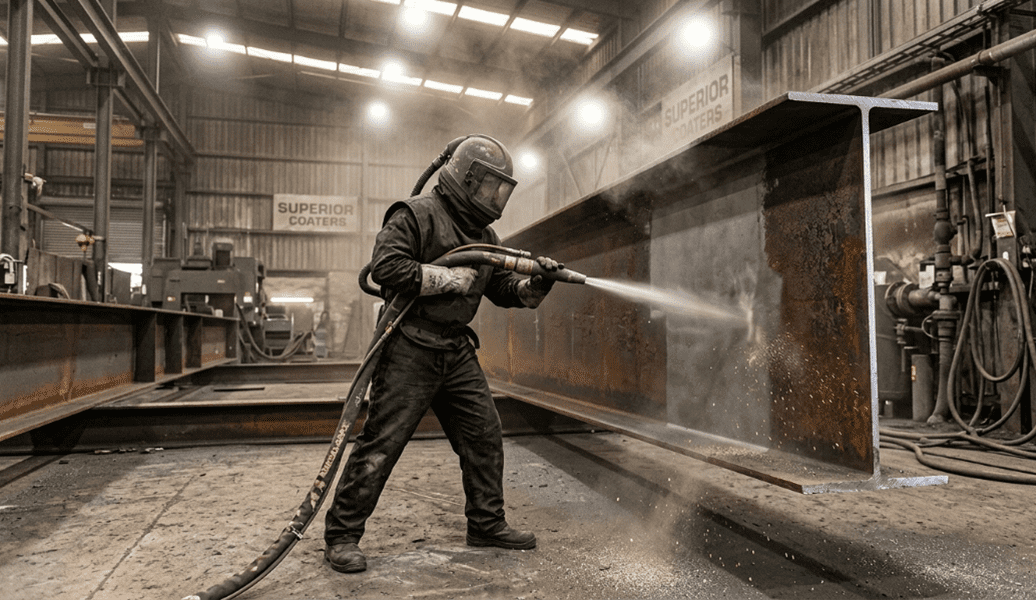
In the world of industrial manufacturing and heavy-duty fabrication, the finish is often the first thing a client sees, but it’s the surface preparation that determines how long they stay satisfied. For high-stakes projects—from infrastructure components to custom industrial machinery—a “cheap” powder coating job is often the most expensive mistake a business can make.
At Superior Coaters, we’ve built our reputation on the philosophy that a coating is only as strong as the bond it forms with the substrate. To achieve a finish that can withstand the harsh Australian climate for two decades or more, you have to look beneath the surface.
The Hidden Enemy: What Happens When Preparation is Skipped?
Many people view powder coating as a purely aesthetic process—a way to make steel look “finished.” In reality, powder coating is a high-performance protective shield. If that shield is applied over contaminants, the results are inevitable:
- Delamination: The powder loses its grip and peels off in large sheets.
- Osmotic Blistering: Moisture trapped under the coating expands, creating bubbles that eventually burst and expose the metal.
- Creeping Corrosion: Rust begins at a tiny chip and spreads rapidly underneath the coating because the surface wasn’t properly profiled to “lock” the powder in place.
By the time you see the rust, the damage is done. This is why surface preparation isn’t just a preliminary step; it is the foundation of the entire lifecycle of the product.
Step 1: Abrasive Blasting – Creating the “Mechanical Lock”
The first and arguably most critical phase of preparation is Abrasive Blasting (Sandblasting). Simply “cleaning” a piece of metal isn’t enough. To ensure a 20-year lifespan, the surface needs a specific “profile.” Think of it like painting a piece of glass versus a piece of sandpaper; the rougher surface provides more surface area for the powder to grip.
At Superior Coaters, our industrial blasting booths remove:
- Mill Scale: The flaky, bluish coating found on new hot-rolled steel. If coated over, the scale eventually pops off, taking your expensive finish with it.
- Existing Rust: Even microscopic oxidation can continue to grow under a fresh coat of powder.
- Old Coatings: To ensure a uniform finish, all previous paint or powder must be stripped back to “white metal.”
By using controlled abrasive media, we create a microscopic “peak and valley” profile on the metal. This ensures the powder doesn’t just sit on top of the metal but weaves into it, creating a mechanical lock.
Step 2: Chemical Pre-treatment – The Molecular Shield
While blasting handles the physical profile, Chemical Pre-treatment handles the molecular integrity of the bond. Even after blasting, metal can harbor invisible oils, salts, and residues from the handling process.
For high-durability projects, we utilize a multi-stage chemical wash. This process often includes:
- Degreasing: Removing heavy oils and lubricants used during the fabrication or machining process.
- Phosphate Coating: Applying a thin layer of iron or zinc phosphate. This acts as a secondary conversion coating that enhances corrosion resistance and provides a chemically “active” surface for the powder to stick to.
- De-ionised Rinsing: Ensuring no mineral salts from local water supplies are left on the item, which could trigger “under-film” corrosion years down the line.
Step 3: The Importance of Prime – Zinc-Rich Primers
In Australia’s coastal environments—where salt spray can travel kilometers inland—a single coat of powder is rarely enough for a 20-year guarantee. This is where Zinc-Rich Primers become the unsung heroes of the process.
We often recommend a two-coat system for industrial applications. The zinc primer acts as a “sacrificial” layer. If the topcoat is ever scratched or gouged by heavy machinery, the zinc will corrode instead of the steel. This prevents rust from “creeping” across the surface and preserves the structural integrity of the item.
As a Dulux and Interpon Accredited Applicator, we match these primers specifically to the topcoat to ensure chemical compatibility, creating a unified barrier against the elements.
Step 4: Electrostatic Application and the Batch Oven Advantage
The final stage of the lifecycle is the application itself. Because powder coating relies on an electrostatic charge, the powder is pulled into every nook, cranny, and weld of a complex fabrication. This ensures an even thickness that liquid paint simply cannot match.
However, the quality of the finish is “locked in” during the curing process. At Superior Coaters, our 14-metre batch ovens allow us to cure massive industrial components in a single, controlled environment.
Why does a batch oven matter for quality?
- Uniform Heat: Unlike smaller or manual setups, our large-scale ovens ensure the entire piece reaches the “metal temperature” required for the powder to flow and cross-link chemically.
- No Cold Spots: Consistent temperature across a 14-metre span means the coating cures evenly, preventing brittle spots or “orange peel” textures.
The Superior Advantage: Quality Assurance and Accreditation
A 20-year finish isn’t an accident; it’s a result of rigorous documentation and testing. As an accredited applicator, our process is audited to meet Australian Standards. We monitor:
- Ambient conditions (humidity and temperature) during application.
- Dry Film Thickness (DFT) to ensure the coating isn’t too thin (offering no protection) or too thick (making it prone to cracking).
- Adhesion Tests to verify that the preparation steps were successful.
Conclusion: Investing in the Future
When you choose a powder coater based solely on the lowest quote, you are often paying for a shortcut in the preparation phase. Within three to five years, the cost of stripping, re-blasting, and re-coating a failed project will far exceed the initial investment in a quality finish.
At Superior Coaters, we understand that your projects—whether they are bridge walkways, mining equipment, or architectural landmarks—are built to last. By prioritizing abrasive blasting, chemical pre-treatment, and precision curing, we ensure that our “Superior” finish isn’t just a name—it’s a 20-year promise.
Ready to protect your next project? Contact the experts at Superior Coaters today to discuss a coating specification that stands the test of time.
