In the world of industrial finishing, the “money shot” is always the moment the oven door opens. Seeing a dull, grey piece of raw aluminium or steel transformed into a vibrant, glass-smooth architectural masterpiece is incredibly satisfying. However, for the veterans at Superior Coaters, that final cure is simply the closing credits of a much longer story.
The uncomfortable truth of the
powder coating industry is this: 90% of coating failures are not caused by the powder or the oven. They are caused by what happened—or didn’t happen—long before the spray gun was even triggered.
When a finish bubbles, peels, or rusts prematurely, it is rarely a “bad batch” of powder. It is usually a failure of Forensic Finishing—the rigorous, scientific process of surface preparation. To understand why your project needs professional intervention, we have to look at the anatomy of a failure.
The Invisible Enemies: Contaminants and Chemistry
To the naked eye, a piece of mild steel might look clean. To a coating specialist, that same piece of steel is a battlefield of microscopic contaminants. If you apply powder over these, you aren’t coating the metal; you are coating the dirt.
1. The “Ghost” of Mill Scale
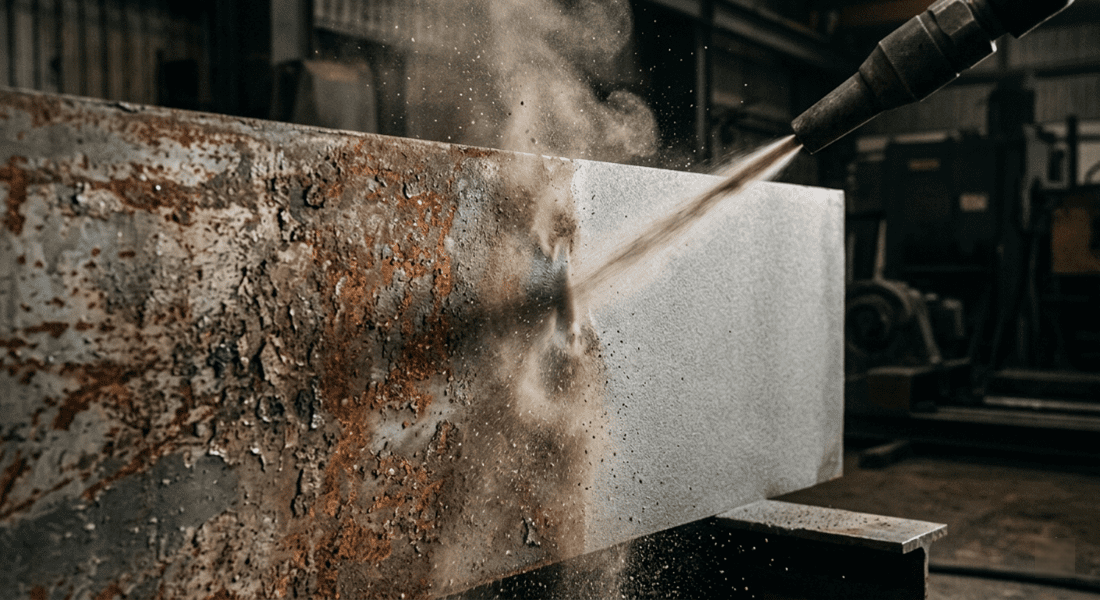
Mill scale is the flaky, bluish-black oxide layer formed during the hot-rolling process of steel. It looks solid, but it is structurally brittle. If you coat directly over mill scale, the powder bonds to the scale, not the steel. When the steel undergoes thermal expansion or physical stress, the scale snaps off, taking your expensive finish with it.
The Forensic Fix: Abrasive blasting (sandblasting) to a “near-white” metal finish. This doesn’t just clean the surface; it creates a “profile”—a series of microscopic peaks and valleys that give the
powder something to “anchor” into.
2. Hydrocarbons and Oils
Even a single fingerprint contains skin oils that can cause “fish-eyes” (small circular craters) in the finished coat. In an industrial setting, the enemies are cutting fluids, rust preventatives, and lubricants.
- The Error: Simply wiping a part with a rag and some hardware-store thinner.
- The Professional Standard: A multi-stage chemical pre-treatment process. This often involves alkaline cleaners that chemically break down hydrocarbons, followed by multiple deionized water rinses to ensure no chemical residue remains.
Anatomy of a Failure: 3 Common “Crime Scenes”
When we are called in to “rescue” a failed coating job from a cut-price competitor, we usually see the same three suspects.
Suspect A: The “Orange Peel” Effect
While some texture is normal in powder coating, excessive “orange peel” (a bumpy surface resembling the skin of a citrus fruit) is often a sign of poor grounding or improper voltage.
- The Forensic Reality: If the part isn’t perfectly grounded, the electrostatic charge builds up unevenly. The powder “clumps” in mid-air before it even hits the metal. This is an Expertise failure—knowing how to dial in the kilovolts (kV) based on the humidity and the complexity of the part’s shape.
Suspect B: Outgassing (The “Bubbling” Disaster)
This is the bane of cast aluminium and galvanized steel. These materials are porous; they trap air and moisture within the metal itself. When the part hits the 200°C oven, that trapped air expands and tries to escape, punching holes through the melting powder.
- The Forensic Fix: Pre-heating. We bake the raw metal before coating it to “gas out” the impurities. We then apply a specialized OGF (Outgassing Forgiving) primer. Skipping this step is the fastest way to ruin a high-end casting.
Suspect C: Delamination (The “Peeling Skin”)
If you can peel your
powder coating off in large sheets like a sunburn, the bond failed at the molecular level. This is almost always due to Flash Rust or Inadequate Etching.
- The Science: For aluminium, we use a chemical etching process that creates a conversion coating (like chromate or non-chromate alternatives). This transforms the surface of the metal into a non-reactive layer that chemically “locks” with the powder. Without this, the bond is purely mechanical and destined to fail.
The Superior Coaters Standard: A 5-Stage Investigation
At Superior Coaters, we treat every project like a forensic investigation. We ask: What is the substrate? Where will it live? What is its history? Our process is designed to eliminate the “90% of failures” before they ever occur.
| Process Step |
Why It Matters |
The Consequence of Skipping |
| Mechanical Prep |
Removes scale, rust, and old paint while creating a “profile.” |
Coating peels off in sheets under stress. |
| Chemical Degreasing |
Removes microscopic oils and cooling fluids. |
“Fish-eyes” and craters in the final finish. |
| Surface Etching |
Creates a chemical bond between metal and coating. |
Creeping corrosion underneath the paint. |
| Deionized Rinse |
Ensures no mineral deposits (calcium/salts) are left behind. |
Blistering and “osmotic” bubbles over time. |
| Precision Drying |
Ensures zero moisture is trapped in joints or pores. |
Sudden “blowouts” and rusting from the inside out. |
The Cost of “Cheap” Coating
In the Australian market, there is always someone willing to do the job for 30% less. However, that 30% saving almost always comes out of the Pre-treatment phase.
Pre-treatment is invisible. You can’t see the chemical etch or the deionized rinse once the
powder is on. A “cheap” job looks identical to a “Superior” job the day it leaves the shop. But six months later, when the salt air of the coast hits it, or the QLD sun causes the metal to expand, the “cheap” job will reveal its secrets.
True Authoritativeness in finishing isn’t about having the best spray gun; it’s about having the most disciplined preparation. We don’t just “paint” metal; we engineer a bond that is designed to last for decades, not just until the invoice is paid.
Conclusion
If you are looking for a finish that stands the test of forensic scrutiny, look beyond the color. Ask about the chemicals, the blast media, and the pre-heating protocols. At Superior Coaters, we spend 90% of our time on the prep, so you can spend 100% of your time enjoying a flawless, durable result.
Is your project destined for a coastal environment or high-traffic industrial use? Contact Superior Coaters today to discuss a coating specification that is built from the substrate up.
 07 3375 6777